RCD Testing

Voltec Maintenance is Your Trusted Electrical Testing Services, RCD Test Tags, RCD Safety Switch Testing and Leakage Current Testing Service Business in Townsville and North Queensland

Voltec Maintenance is a local business based out of Townsville, specialising in preventative electrical testing and maintenance. One of the four main things we do is conduct RCD electrical testing in Townsville.

What is a Residual Current Device Testing, RCD, & RCD Test Tags?

An RCD (Residual Current Device) is a sensitive safety device that switches off electricity automatically if there is a fault. They are also commonly referred to as a Safety Switch. RCDs are in the switchboard and their function is to protect circuits, by tripping power in the event of earth leakage or equipment failure. It continuously monitors the electric current flowing through the circuits it is used to protect.

Having RCDS will prevent electrocution from being fatal. It is vital to the safety of your workplace that your RCD safety switch testing is conducted on a regular basis as they can fail and do have to be replaced from time to time. Failure to replace RCD's can result in a potentially fatal situation. This highlights the importance of RCD safety switch testing, to prevent electrical faults where electricity leaks from the circuit (leakage current testing).

Electrical Testing and RCD Test Tags Standards

In Australia, RCD test tags and testing must meet a set standard. This is the AS/NZS 3760:2010 in-service safety inspection and testing of electrical equipment. Once leakage current testing has been conducted, the electrician will place RCD test tags on your equipment to show it has met the electrical testing standards and the due date for the next test. Your device must meet the RCD test tags requirements to ensure that it will respond in a fault situation. If it fails, the test (maximum allowable earth leakage current) it will be removed from service and replaced or repaired.

The Maximum Allowable Earth Leakage Current and Leakage Current Testing

RCDs are designed to quickly disconnect a circuit when it detects that the electric current is not balanced between the supply and return conductors of a circuit. Any difference between the currents in these conductors signifies that there is a leakage current, therefore creating a shock hazard. Hence, the importance of leakage current testing and maximum allowable earth leakage current standards. The central protective measure for electrical safety is good insulation. It ensures that no one touches any live conductors and that a short circuit does not occur. Leakage current testing will tell you all about the quality and safety of the insulation. This test is conducted during actual use of the product and determines if the current leakage is too high from the insulation to the housing. It is both a safety and functional test.

The maximum allowable earth leakage current can vary for each piece of electrical equipment, depending on its use and construction, so leakage current testing should always be done by experienced and trained electricians.

Leakage Current Testing for High-Voltage Circuits

For high voltage circuits, regulation 5.24(2) requires the earth leakage protection device to operate at the maximum allowable earth leakage current not exceeding 2 A. This must be achieved in the context of safe step and touch voltage limits.

Leakage Current Testing for Low-Voltage Circuits

For low voltage circuits, regulation 5.24(2) requires the earth leakage protection device to operate at the maximum allowable earth leakage current not exceeding 1 A. This must be achieved in the context of safe touch voltage limits.

Contact us today for a free quote on leakage current testing.

RCD Testing Service Reports After Testing

Our licensed electricians at Voltec Maintenance meticulously test each RCD using advanced load and trip test equipment to ensure precise readings. After testing, we provide detailed reports indicating pass or fail status. If any defects are found, we promptly recommend repairs, replacements, or upgrades to maintain safety compliance. This ensures a streamlined auditing process and freedom from worry.

What Types of RCD Safety Switch Testing is Performed?


RCD Load Testing

Load Test

A load test can be performed on most power circuits by a technician with a Restricted Electrical Licence. This test measures the power consumption of the equipment when in use. A load test provides a good indication of the equipment’s operating condition.  The technician will utilise an RCD tester by plugging it into a power point, tripping the circuit and recording the result. The technician will have to go back and forward to the switchboard to turn the RCD back on between testing 0 and 180 degrees. It is important that the client understands this test is not only testing the RCD, but also the circuit itself. This is a very thorough test if performed correctly and identifies if the RCD and circuit performs effectively. Furthermore, a load testing regime performed on your site will also include the identification of safe Power Points. This is an essential component of RCD safety switch testing.

Injection Testing

Injection Test

This electrical testing is performed by a qualified electrician by opening the switchboard and tripping each individual circuit. While doing this, the electrician notes down the specific figures at which the circuit trips at both 180 and 0 degrees. The result of this test per circuit is both results added together and divided by two. For example, DB1 Cb32 tripped at 18 & 31 would have a result of 25. It is important that these results are accurately logged and kept for historical data as RCD's trending towards failing over 300 can be identified and replaced, before they fail and result in a potentially fatal situation. A benefit of injection testing will be the real testing of lighting and fixed power circuits. Therefore, it is important to have a qualified electrician perform your RCD safety switch testing.

Push Button Test

A push button Test is conducted by pressing the button located on the RCD which in turn trips the RCD. The functionality of this RCD is proven by the RCD successfully tripping with the pushing of this button. It is important all push button tests are accurately reported pertaining the individual Switchboard and Circuit Breaker. A push button test is not a completely reliable assessment that the RCD is functioning correctly, therefore it is important that regular electrical testing is completed by qualified electricians. A push button test should be completed at minimum 3 monthly intervals.

Portable Load Test

This test is commonly conducted on portable appliances that contain an RCD. It is important to isolate this test, so your site is not affected by the trip in the situation that the RCD does not work. The equipment is inspected visually, followed by verification of earthing (grounding) continuity, and the quality of insulation between the current carrying parts, and any exposed metal that may be touched is tested. Most portable items containing RCD's will need electrical testing done at more frequent intervals.

Portable Push Button Test

This test is conducted by plugging the portable appliance into power and testing the functionality of the RCD by pressing the push button. This test is most conducted on power boards that contain RCD's. This quick and simple test is commonly used with portable RCDs and should be performed daily or before each time you use the equipment – whichever is the longer. However, it is not particularly accurate and should never be relied on as a reliable assessment of the equipment working correctly.

Want more information about electrical testing? contact us today for a free quote. Learn more about our Test & Tag services, Fire protection services, or Emergency Exit Light Testing services.

Intervals of RCD Electrical Testing

Fixed RCD Testing

  • Fixed RCD Testing QLD
  • Push Button testing to be conducted at 6 monthly intervals 
  • Load or Injection testing to be conducted at 12 monthly intervals 
  • Portable RCD Testing
  • Load Testing to be conducted at 12 monthly intervals 
  • Push Button Test to be conducted by user prior to use 

Portable RCD Testing

  • Load Testing to be conducted at 12 monthly intervals 
  • Push Button Test to be conducted by user prior to use 

Electrical RCD Testing FAQs

What is RCD Testing?

RCD testing checks that a Residual Current Device (RCD) is working properly and will quickly cut power if there’s a fault or electric shock risk (usually at 30mA).

There are four main types of tests:

  • Injection testing: Done at the switchboard by a licensed electrician to test the RCD directly.
  • Load testing: Tested from a power point using specialised equipment to simulate real conditions.
  • Push button test: Pressing the test button to make sure the RCD trips.
  • Portable RCD testing: Testing portable devices using an isolation setup.
RCD vs PRCD: Why are they needed?
  • Back in the day, not all circuits were protected by rcd. Some where on circuit breakers and before that fuses. Using a portable rcd, ensures that protection is available without guess work.
  • Portable rcds are often used in construction work and commercial cleaning.  
    How often should RCDs be tested?
    • Depends on the environment.
    • Be aware of the relevant legislation, as there are two main requirements to follow. In QLD, these include the WorkSafe QLD table and the AS/NZS 3760 standard.
    • As per WorkSafe QLD table, an office work environment should have an rcd test of a fixed rcd every two years. Manufacturing work should have it done every 12 months. Each of these industries also have it on a 6 monthly basis.
    • There are other areas of legislation that also impact this, you are responsible for the safety of your personnel and people using your site.
    • Our recommendation is a routine 12-monthly load or injection test, along with a 6-monthly push button test. As well as clear understanding as to if your entire site has RCD’s in place. If it doesn’t, I would encourage a rigours test and tag program where everything is tested.
    What are the signs that an RCD may need testing or replacement?
    • Tripped circuits 
    • Nuisance tripping
    • Test button does not trip
    • No testing records 
    • Age 
    • Recalled rcd
              Can I test my own RCDs?
              • You can perform the basic user testing, which is push button testing, this is done at different intervals, for example in heavy environments prior to each use, in other environments, this is done 3 and 6 monthly. 
              • You are not able to perform injection or load testing; you would have to be a competent person and have the appropriate tools. 
              • Furthermore, even if you are, the question is, in the event of a safety electrical incident, do you want to be defending the incident and your own testing? Or would it be better if you had results and records from an external qualified person to fall back on?
              What happens if an RCD fails a test?
              • If an RCD fails a test, failing to repair that rcd would leave you at risk, if someone was to receive a shock, no rcd would trip, which could potentially result in a fatality.
              • Another potential example would be the rcd failing and being unable to be switched back on. This would be due to a fault appliance connected to the circuit or a fault in the circuit. This would result in a continued loss of power to that circuit if it was not rectified.
              • An RCD that fails, should be tagged out and locked out upon failing, this circuit should not be reenergised until the rcd is replaced. 
                  How to test a 3 phase RCD?
                  • There are a few different tests to understand here, a visual as well as a push button test is the first most basic test. Moving on from this we have the option of a load test, this is where a 3 phase attachment is added on to the end of the tester, plugged into the 3 phase outlet and then the test takes place at 0 and 180 degrees. Another option is the injection test where you test between L1, L2 & L3 and earth. Different from single phase testing where you test between the active and neutral.
                  • So it is important to understand, if you are testing in the field, it is important to perform the appropriate tests. If using an appliance tester, the regular RCD test option that you would use on single phase is not enough. You have to use the 3 phase option and have the awareness and understanding of what you are tripping.
                  What does the Voltec testing process look like?
                  • Visual check & push-button test
                  • Phase-to-Earth Testing (L1, L2, L3):
                    • ½ IΔn → Must NOT trip
                    • 1 × IΔn → Test at 0° & 180°
                    • 5 × IΔn → Test once
                  • Acceptance (30 mA RCD):
                    • 1 × IΔn → ≤ 300 ms
                    • 5 × IΔn → ≤ 40 ms
                  • Optional: Ramp test (find actual trip current)
                  • Record:
                    • Trip times, phase, pass/fail, technician, date
                  • Final: Tag the RCD after testing
                  Does everything need to be RCD protection?
                  • Most circuits should be protected by RCDs. In particular, all power circuits, lighting circuits, and other fixed electrical installations should be considered for RCD protection.
                  • However, it is important to understand the potential implications of installing RCDs in series (i.e., “RCDs on RCDs”), as this can lead to nuisance tripping if not properly coordinated.
                  • For older buildings, conducting an audit of existing RCD protection is highly recommended. This helps ensure that all relevant circuits are adequately protected and that no areas have been overlooked.
                  • From a best-practice perspective, if managing an older building—especially one occupied by staff—it would be prudent to ensure that every power outlet is RCD-protected. A practical method to verify this is to use an RCD tester to check each outlet individually. As each outlet is tested, a temporary label or marker can be applied to confirm it has been verified, reducing the risk of leaving any outlet unprotected.
                  • This process can become more complex in practice. If an electrical contractor who does not specialize in preventative maintenance is engaged solely to perform injection testing of RCDs, it may create a false sense of security. For example, a contractor may test a limited number of RCDs at the distribution board—perhaps six devices serving around 25 circuits—without fully verifying which circuits are connected to each RCD. In older installations, circuit labeling is often outdated or unreliable, further complicating this assessment.
                  • To comprehensively confirm that all required circuits are RCD-protected, a thorough verification process is needed. This typically involves testing circuits throughout the entire building, which can be time-consuming and potentially disruptive to normal operations.
                  What are the safety precautions to be taken during RCD testing? 
                  • If an electrician is performing injection testing in the board this is a higher risk task. This task should involve a spotter who has LVR and CPR in date and various elements of PPE such as gloves, long sleeve shirt and pants, appropriate boots, safety glasses or visor. The amount of safety involved depends on the board being tester, is it single phase or 3 phase etc. the electricians on site should also perform a prestart and SWMS prior to commencing testing.  
                  What are the common causes of RCD tripping?
                  • Faulty appliance
                  • Overload
                  • Short in the circuit due to water ingress, for example an external light that has filled up with water due to rain or humidity and moisture.  
                      What is the standards for RCD testing?
                      • AS  3760 core standard for test and tag and rcd testing
                      • As 3000 – installation standard “where rcd’s must be installed and required ratings”
                      • As3012 – hazardous environment  
                      • As3190 product standard  

                            The Voltec Maintenance Difference

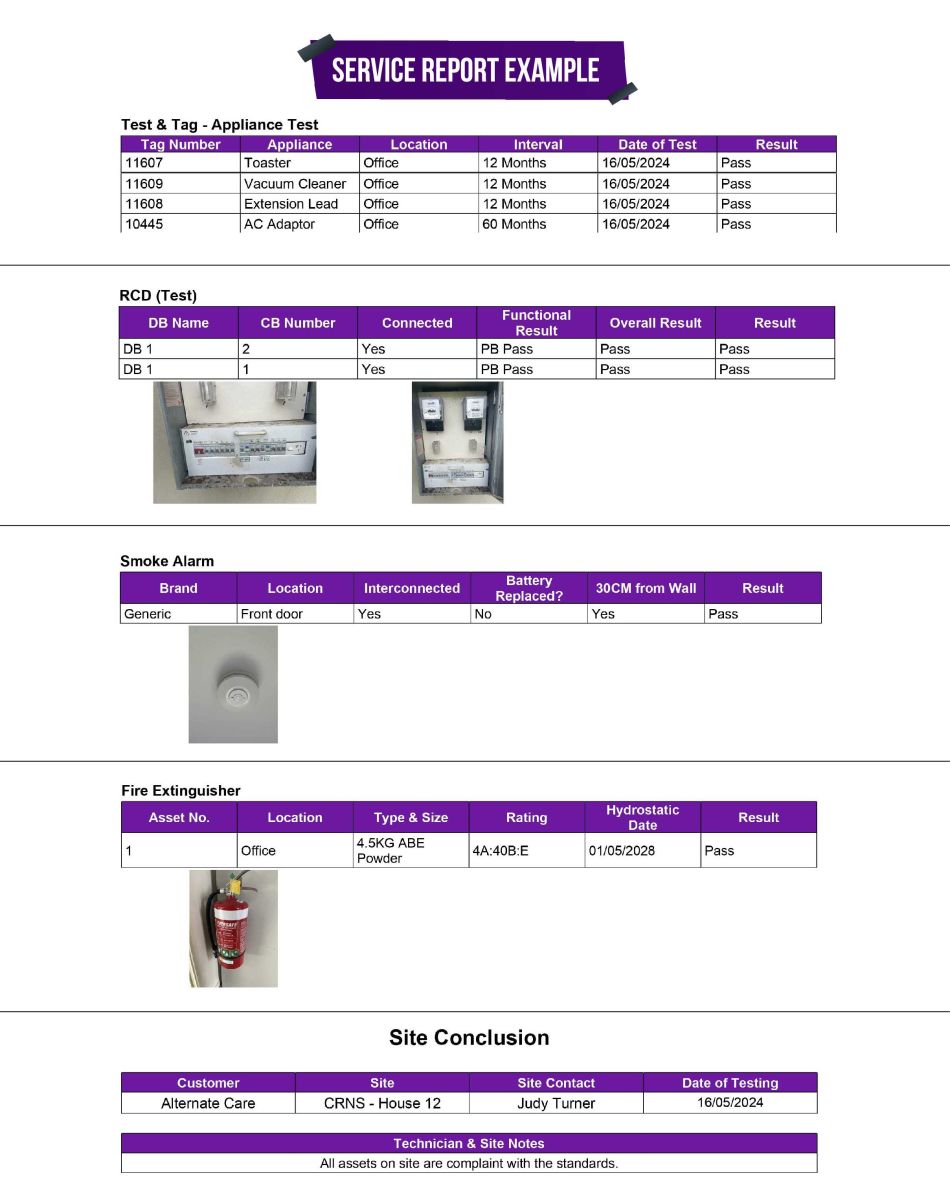
                            Our reporting system is proven and tested. We will ensure that you have always reporting in your hands. No tricks or games like other companies who store your data online so they can quickly pull it in case you leave as a customer. Each switchboard is documented by way of a photo. Which will be included in the excel file as demonstrated below. The results will then be specific down to each individual circuit breaker. As time goes on, new results will be added, and historical results will be kept. Identification of trending RCD's will be communicated and displayed on the sheet. As we complete the electrical testing or RCD safety switch testing, RCD test tags will be added to ensure compliance and make it easy for you to see what has been completed and when.

                            Are you a local business looking for RCD test tags services? Contact us today to get a quote. Learn more about our Test & Tag services, Fire protection services, or Emergency Exit Light Testing services.

                            Get a Free Quote for Your RCD Safety Switch Testing Services.

                            Call us today to get free expert advice or a no-obligation quote. We believe in doing the job the right way, not the easy way.

                            In addition to general Electrical Testing and RCD Test Tags, we are specialised in commercial electrical services. Are you looking for a commercial electrician? Learn more about our Fire Equipment Testing, Electrical Test and Tag, or Emergency Light Testing.